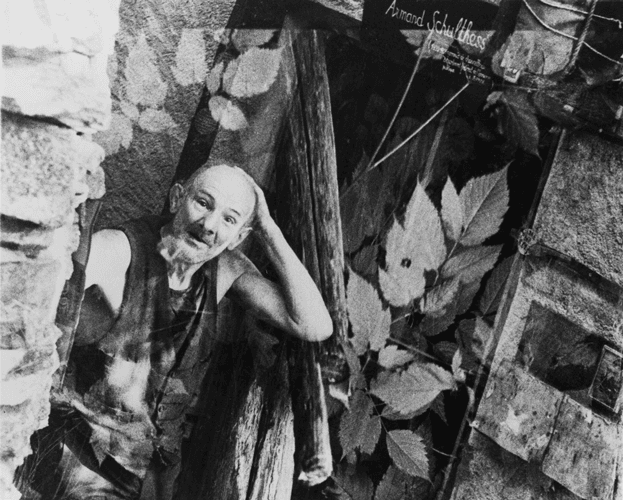
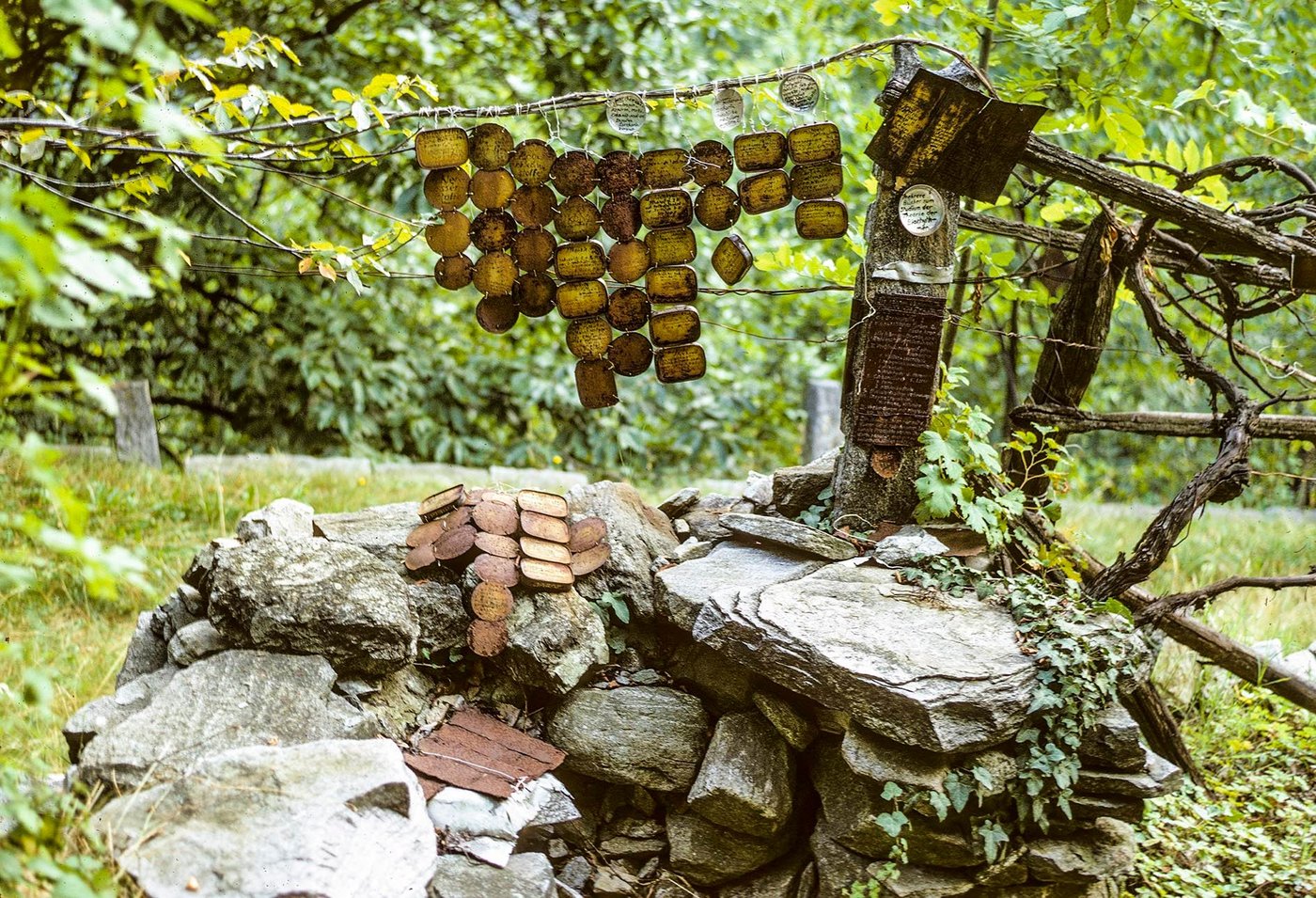
Armand Schulthess was born in Neuchâtel. As a young man, he obtained a business degree before undertaking an apprenticeship in an import‑export company. He then became the owner of a women’s clothing manufacturing business based in Zurich, then in Geneva, but the firm went bankrupt. In 1939, he was hired as an office employee at the Federal Department of Economic Affairs in Bern. At the age of fifty, this civil servant of the Swiss Confederation abruptly severed all his professional and social ties. He permanently left his job and chose as a place of exile, both geographic and mental, a country house in Ticino that he had acquired ten years earlier. Cut off from the outside world, he thereafter devoted his life to developing the vast land surrounding him. Upon his death, his heirs decided to destroy his work. Only a few of his books, as well as a series of assemblages made from metal sheets, wire and twigs, will be preserved.
The German‑Swiss filmmaker and photographer Hans‑Ulrich Schlumpf was able to document and immortalize this monumental work as it existed before its destruction. In the exhibition, his photographs will dialogue with nearly 300 objects taken from the environment, which were saved at the last minute, including a very significant corpus acquired in 2024 by the Collection of Art Brut, and unveiled here for the first time on the occasion of the Lausanne museum's fiftieth anniversary.
In 1976, the year of its inauguration, it devoted its first temporary exhibition to this artistic production, with Hans‑Ulrich Schlumpf as curator. Fifty years later, a rethought presentation accompanied by previously unseen pieces allows us to take a fresh look at Armand Schulthess's extraordinary oeuvre.
Commissioner: Hans-Ulrich Schlumpf